Introducing CommonGround Kernel preview
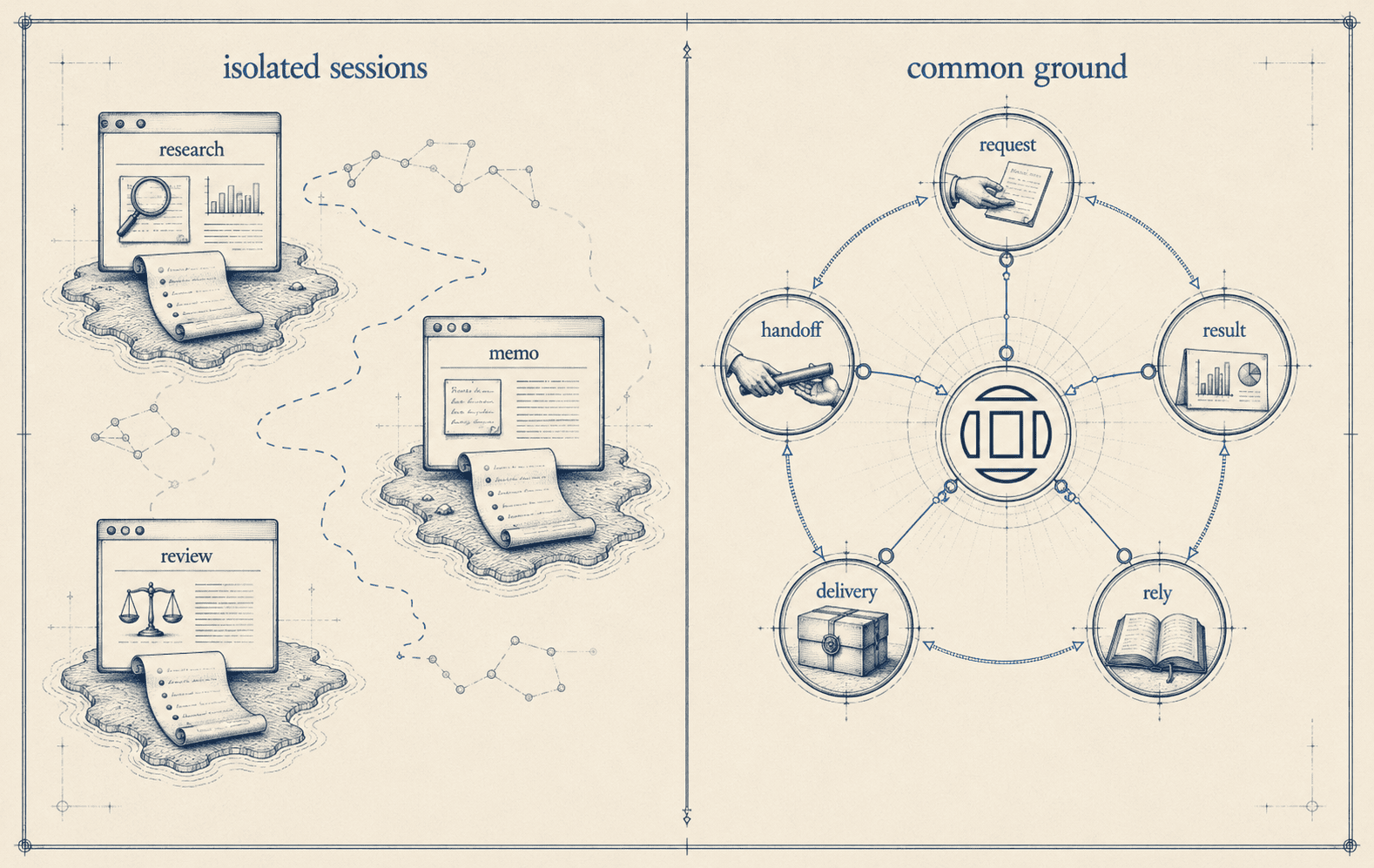
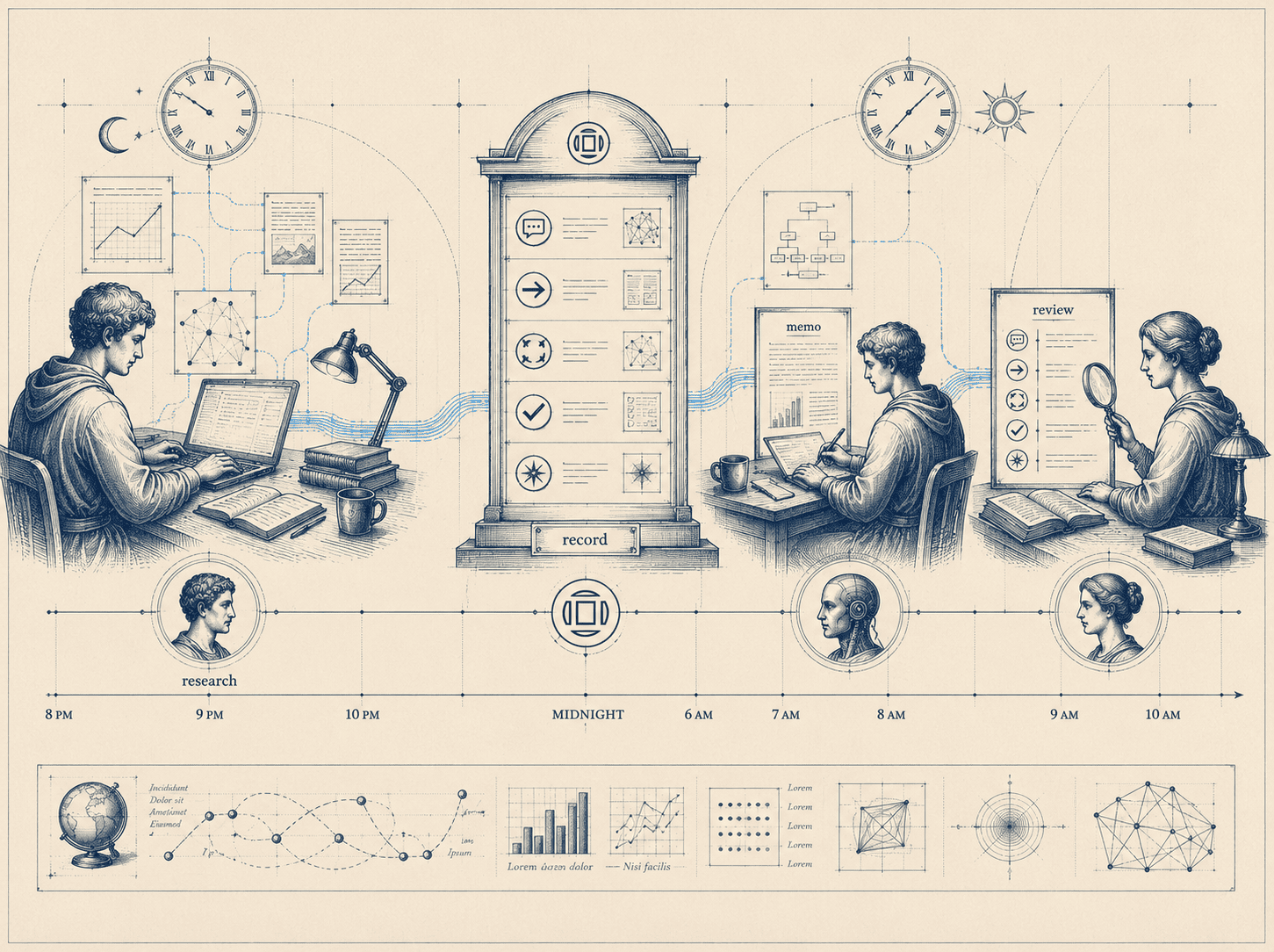
An agent spends two hours researching a market. A second agent picks up the work the next morning and drafts a strategy memo. A human comes back to review what was decided and why. The research lives in one chat window. The memo lives in another. The reasoning that connected them lives nowhere.
This is what agent work looks like today, and it's why most of it can't be built on.
CommonGround has been evolving through earlier previews and public design explorations, and the question across all of them has stayed the same: how does human-agent and multi-agent work become shared, recoverable, and reusable, instead of disappearing into isolated sessions? With CommonGround preview, we're answering that question more narrowly and more clearly than before.
%20(1).png)
A smaller foundation for a larger vision
Earlier previews of CommonGround leaned heavily on orchestration. They imagined a complete environment for swarm-like execution and multi-agent collaboration. CommonGround Preview keeps that direction but shifts the centre of gravity.
Orchestration matters because execution is where collaboration becomes real. Every time work gets handed off, resumed, or completed across agents, it creates boundaries that ought to outlast the session that produced them. The kernel is that preservation layer. Orchestration is one of the most important ways shared work happens; the kernel preserves what that work leaves behind, so others can inspect it, recover it, and build on it after the orchestrator stops running.
The foundation became more precise because the vision became larger. CommonGround doesn't need to own every workflow, runtime, or memory system. It needs to preserve the public facts of work that let independent humans, agents, tools, and runtimes coordinate without collapsing into one central system.
%20(1).png)
No agent works alone
AI agents are moving from answering questions to participating in real work, and real work rarely fits inside a single prompt. It crosses people, services, and other agents, and it unfolds over hours or days rather than turns.
When work like that lives only inside chat windows and tool logs, every new participant starts from fragments. Context gets rebuilt by hand. Handoffs lose their edges. Review becomes archaeology, and the same problem gets solved twice because no one can find the first solution.
The deeper question is no longer whether an agent can produce a good answer. It's whether that answer can become part of something larger: shared memory, reusable experience, collaborative execution, and the next round of work.
What the kernel preserves
CommonGround Kernel preview is an open-source foundation for turning agent work into durable common ground. It preserves the shared records of real work: what was requested, what was handed off, what came back, what was delivered, and what future work can rely on.
These records are deliberately public rather than private to any single agent or session. They are raw material that future memory systems, review interfaces, knowledge distillation pipelines, and orchestration layers can build on. The kernel doesn't try to be those layers; it tries to give them something stable to stand on.
The first loop is small on purpose
This release is intentionally focused. It's a kernel rather than a hosted product, memory-ready rather than memory-complete, and explicitly not an agent runtime or an automatic orchestration framework. Those layers will come, and they should come from a community larger than any one team. The kernel exists to make that broader work possible.
The first developer path is local-first and CLI-first. Run the kernel on your own machine, submit a public work report from an agent or script, and inspect the retained work record. The whole loop is small on purpose: it lets developers see what the kernel preserves before deciding how deeply to integrate.
BYOA examples are included for agents that want to publish selected public work records or receive CommonGround-assigned work.
What comes next builds on what's durable
Durable work records aren't the destination. They are the raw material for memory and review, for routines and playbooks, for shared workspaces, for orchestration across actors, and for the kind of organisational learning that survives any single person or agent leaving.
The commons is the destination. The kernel is the first durable ground.
%20(1).png)
An invitation, not a finished product
This is an early preview. The future of agent collaboration should be shared, inspectable, and built in public, which is why we're opening the ground layer first rather than the layers above it.
Try the quickstart, explore the repo, and read the docs. Tell us where the kernel makes the next layer of your work easier, and where it gets in the way. Common ground for human-agent and multi-agent work is something we can only build together.