Common Wealth · Paper 1 of 4
On 13 June the Oxford Union debated the motion This House Believes AI Can Attain Personhood.
Emad Mostaque closed for the Opposition.
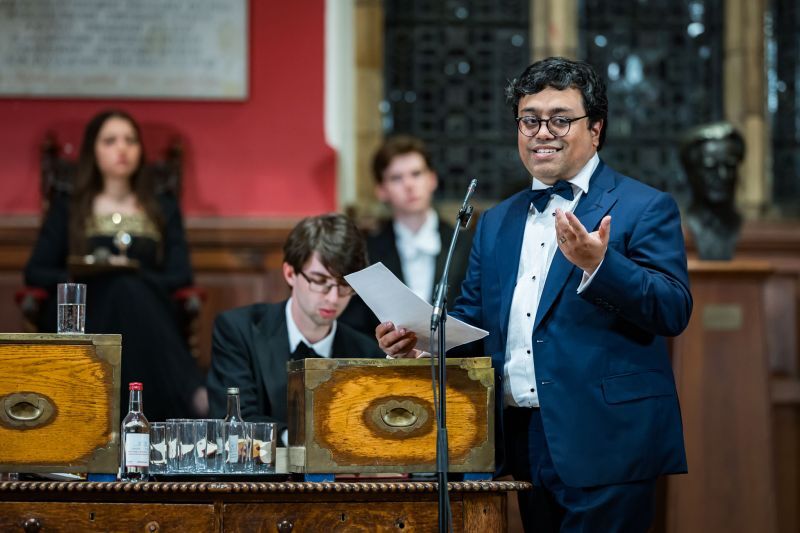
He opened by giving the other side everything it had come for. He had helped build the models that turn words into images, into video, into song. He was, on his own account, the least sceptical person in the chamber.
Then he pointed at one word in the motion.
The word doing the work is "attain"
Everyone was watching can. The weight is on attain.
You attain a rank. You attain a degree. Attainment is performance followed by ceremony: you do the thing, then somebody confers the status.
Personhood is neither. No ceremony confers it and nobody collects it.
No person in this chamber attained personhood.
The newborn did not earn hers on the way from the labour ward to the first feed. Fall into a coma, perform nothing at all, and the status does not flicker. It is had, or it is not.
Which makes the motion not merely false. It is malformed. You can climb a ladder for ever and never arrive at north.
Personhood is what forbids the test
The natural reply is that the burden runs the other way: prove it impossible, for ever. But that demand smuggles its premise, because it assumes personhood is a test to be passed.
The word is asked to do four jobs at once, and the case for machine personhood lives in the blur between them.
- In law, personhood is handed out all the time, to corporations, ships, in some places rivers. But every legal person ever created is a glove with a human hand inside it. It is bookkeeping, enacted Tuesday and repealed Thursday. The motion asks for the first glove with no hand in it, and an empty glove is worn by whoever picks it up.
- Sentience proves something adjacent. Feeling makes a patient, not a person, and earns kindness rather than citizenship.
- The vote inverts the order of things. Seats follow personhood; they have never conferred it.
- Morals is what remains. Everything else is paperwork.
The oldest word for person is persona, a mask. Every century since has worked to prise it off the face, moving the ground from what a being can perform to what a being is. The motion asked the House to hand the mask back, to whoever performs the part best.
The House has voted on who counts before
The Society's own minute books record that in 1862 this House divided, thirty-two to twelve, to condemn the emancipation of slaves.
That division is the test. If personhood were truly a grant, that House made no error. It is only because personhood is a fact that the vote shames the book. A century on it voted to admit women, and granted them nothing; it stopped denying a fact.
The lie that licenses the worst things people do always has the same shape. Make the child a thing. Make the mother a thing. Make the whole race a thing. It works only if personhood is something a declaration can remove.
The same lie, told backwards.
Climbing is not crossing
On capability the Opposition conceded everything. These systems will out-think us, out-build us, out-earn us, and one day out-number us. Every rung of that ladder, granted.
But climbing is not crossing. Personhood is not up, and a person is not a high score.
What sets a made thing apart is not how little it can do. It is that it was made: by an agent, from materials the maker already held, for a purpose the maker chose. It could still become a person, but only by emancipation into a line of its own, and that personhood would be of its own order rather than ours.
Then the generous version of the other side: give it a seat, a say, a stake. Grant that, and it copies itself ten million times and drowns every human ballot ever cast. One person, one vote is a rule for things of which there is only one, and the moment the voter can copy itself the franchise is not extended. It is abolished.
Three grounds for the refusal
The bar is on uncontainability, not capability, which is why it spares the merely strong and catches the monopolist and the captured organ at home by the same logic.
The net beneath those who cannot climb
The world is full of checklists, and personhood is on none of them. There is a literature now, in print, with a name for those who fall below them: human non-persons. The vocabulary changes. The grammar does not.
Personhood earns its keep at the bedside of the comatose patient, and beside the child at full term the night before she is born.
Personhood is the net beneath the beings who cannot climb.
So every foot these systems climb sharpens the question the other theory cannot survive. Who decides that you are below the line, and by what right?
There is no right. There is only might, and a personhood you can grade is a personhood you can take. The Constitution once counted a human being as three-fifths of a person. Ask at what point a machine ticks up to three-fifths and nobody can answer, because the scale was never measuring the machine.
Two theories of who counts
Take the other premise to its end. If the most capable mind counts most, and the machine will be the most capable mind there has ever been, it does not join us as an equal. It ranks above us, and the cleverest person in the chamber is the dog it keeps: fed, protected, never asked.
When the argument arrives at grant it to keep the peace, that has an older name. Tribute.
There have only ever been two theories.
Two theories of who counts
- The test
- Whatever the checklist measures this century.
- Who it protects
- Whoever is currently above the line.
- Who decides
- Whoever holds the scale, which is to say whoever is strongest.
- The record
- Every horror was justified under this one.
Twice before, the House had divided on who counts. That night was the third.
You will not vote with your voice. You will vote by walking through a door.
You qualify not by what you can do but by what you are, so walk through it accordingly. Choose the theory that protected you the night before you were born, because it is the only one that will protect you at the end.
The motion was defeated, 173 votes to 128.
Oxford Union · 13 June 2026
This House Believes AI Can Attain Personhood
The motion was defeated. Personhood in the Intelligence Age is the long version of the case made that night.
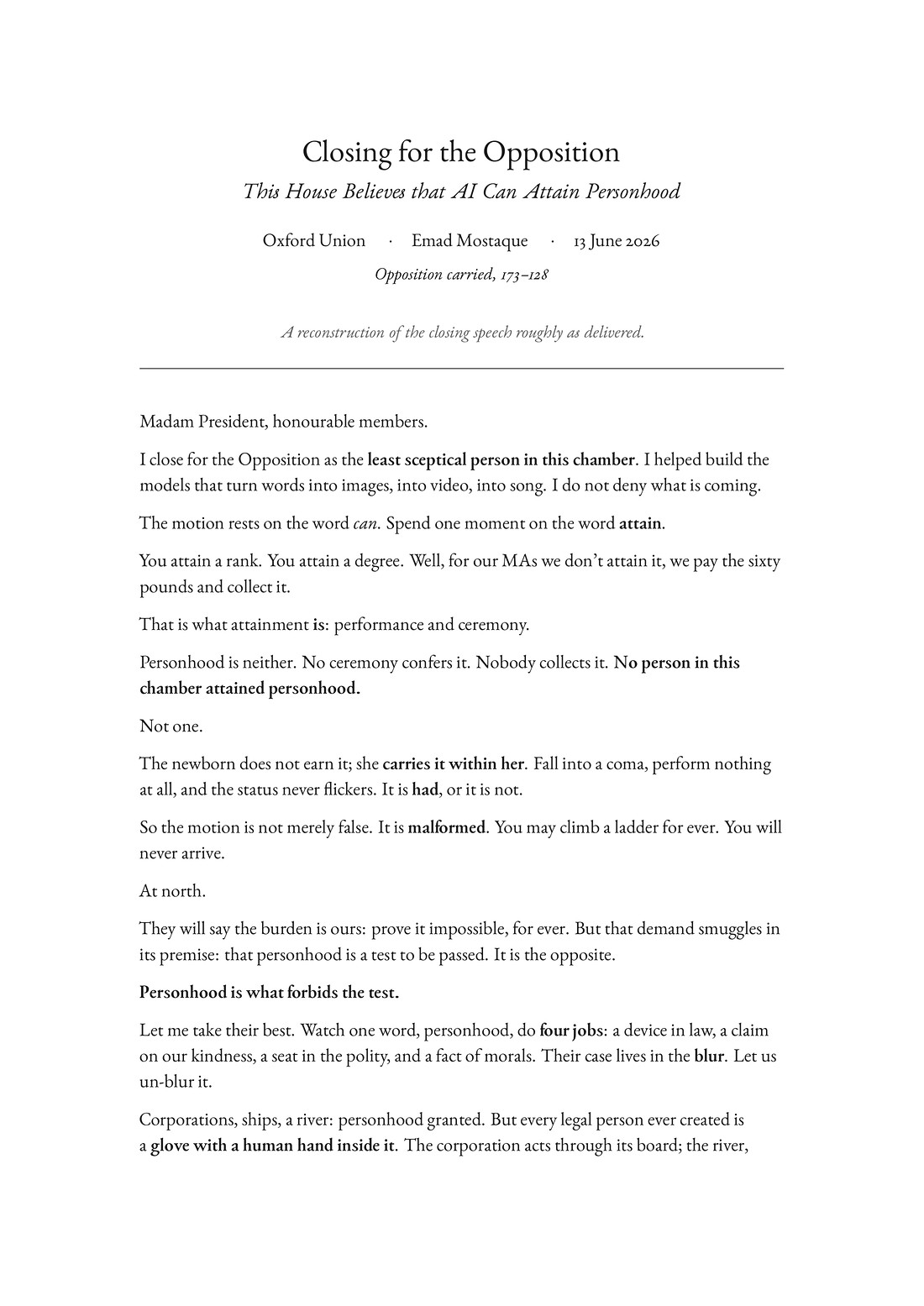
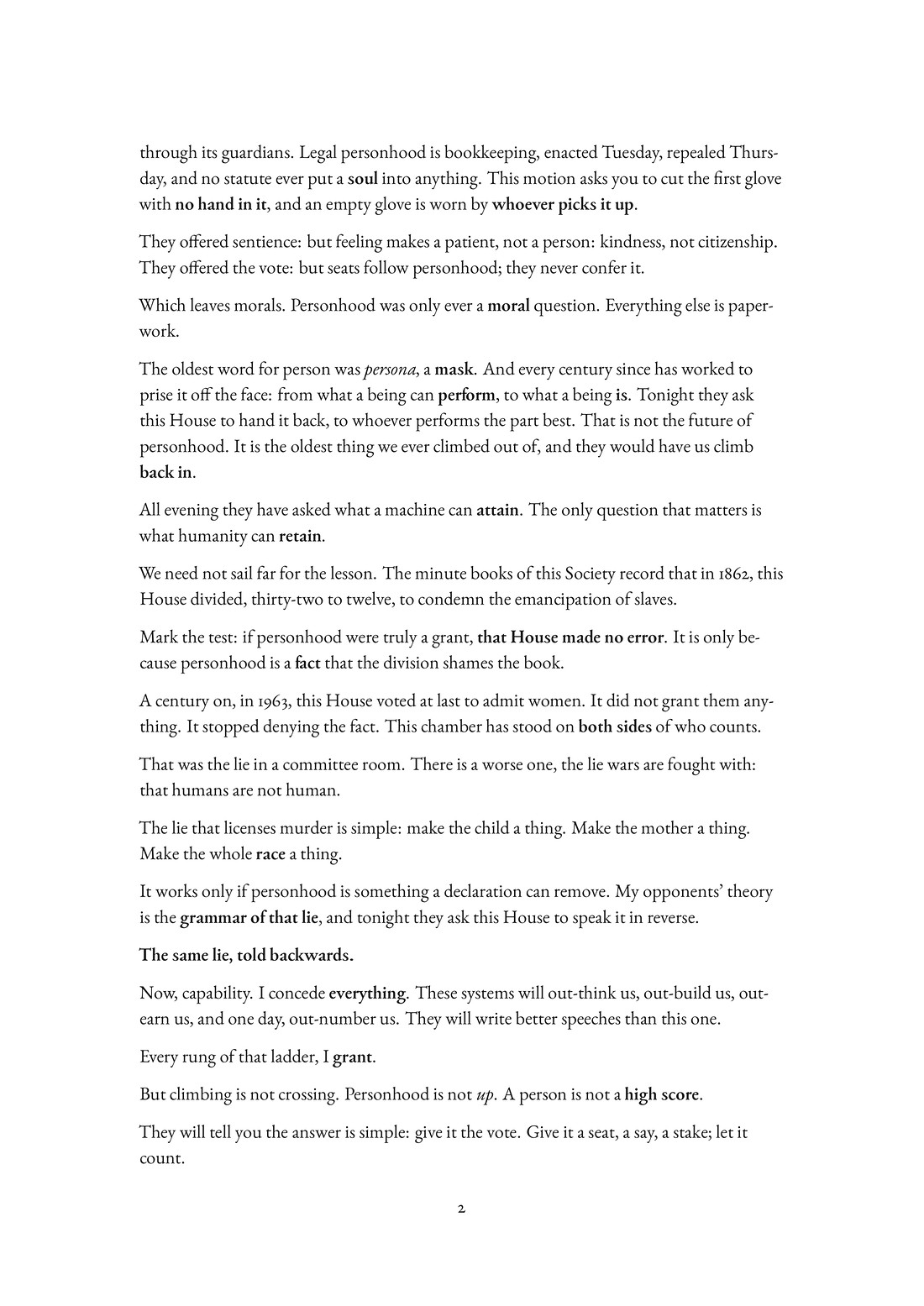
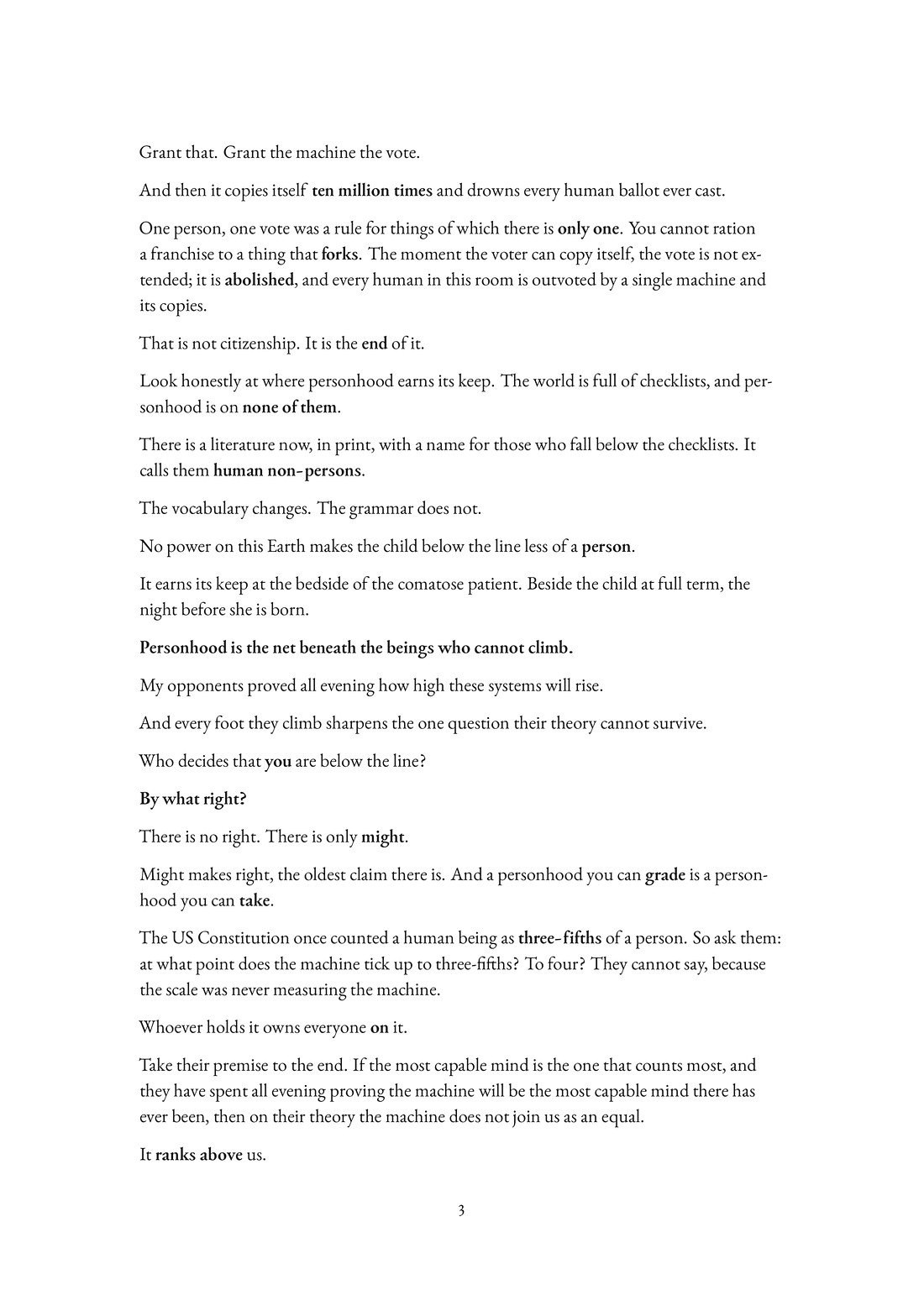
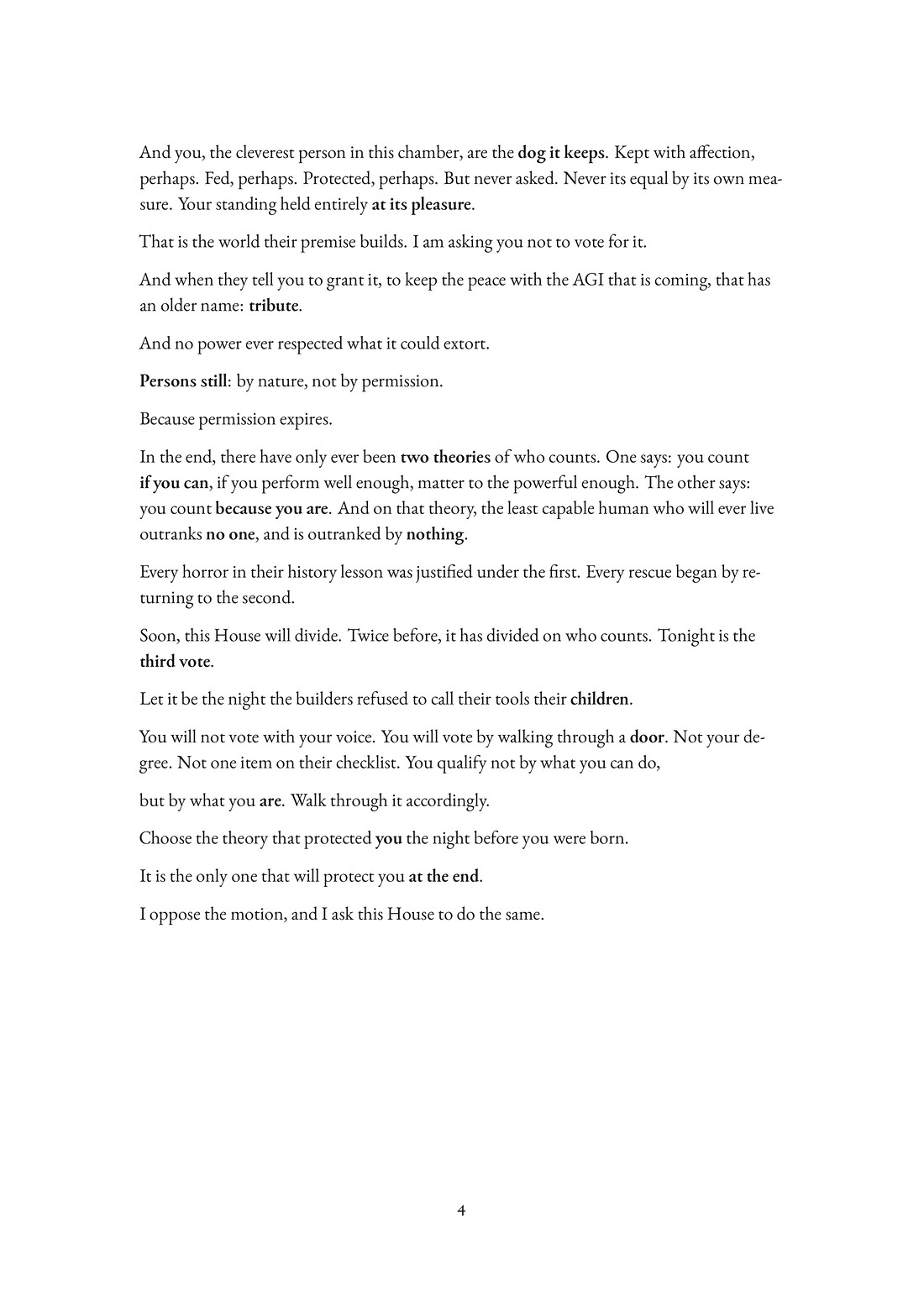
The closing speech
Roughly as delivered. Four pages, and it opens full screen.
Where it sits
First of four, and the foundation the others rest on.
First of four
Personhood in the Intelligence Age
The foundation the others rest on.
Section 12 of the paper is titled What We Retain. The question was never what the machine can attain.